
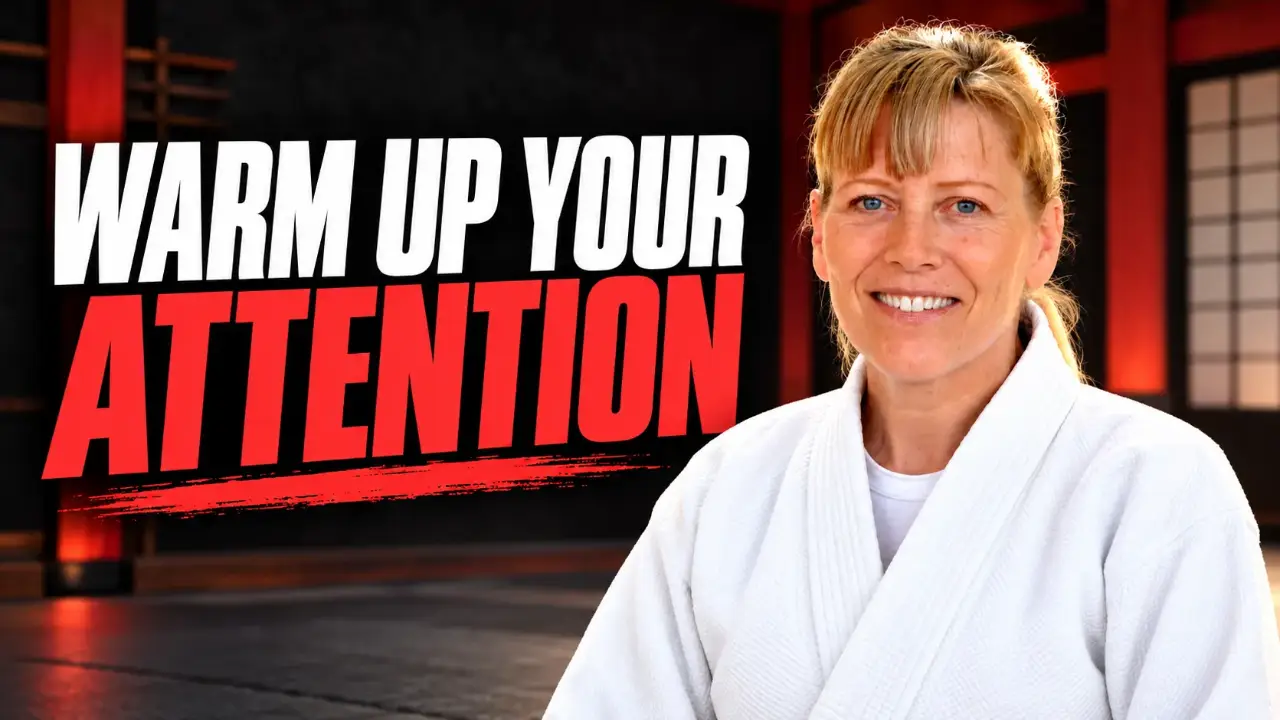
In my first Aikido class in Japan, back in 1987, I showed up ten minutes early, bowed onto the mat, and started stretching. My teacher watched me from across the room and said nothing until class began. Afterward, he pulled me aside.
"You arrived on the mat," he said, "but you did not arrive at ...
I've been doing Aikido for about forty-five years, and I've never trained another martial art. That's a deliberate decision, so I'm not going to compare Aikido to other arts, I genuinely can't. What I can tell you is what Aikido has asked of me, and it turns out to be a specific and demanding lis...
When I survey new students at my dojo about why they came to Aikido, the most common answers are self-development, discipline, focus, managing anxiety, self-defense, and fitness. After thirty years of teaching, I'd say they're right about what they're looking for. Most of them just don't yet know...
In forty-five years of Aikido, I've walked into hundreds of dojos around the world: Japan, Europe, the United States, Australia, China, and more. You can tell a great deal about how people train before anyone sets foot on the mat.
I remember being invited to teach at a dojo where a beautiful pho...
I've been teaching Aikido for over thirty years, and I've watched hundreds of students hit the same wall at roughly the same point in their training. The ones who got through it almost always did one specific thing differently, and it wasn't more classes.
I had a student, maybe second kyu or fir...
I was sitting in a coffee shop in Japan with Yamaguchi Sensei and some of his students, near Ochanomizu Station, right after training. I was maybe shodan or nidan at the most. I was blown away, first by the range of topics he pulled into the conversation, and second by how often he drew me in, de...
Every serious practitioner has had this experience. You come home from a seminar confused. Your technique feels worse than when you left, and you can't fully explain what you spent three days doing. This is not a problem. This is the seminar working.
I had a student who came back from a seminar ...
There's a specific moment in Aikido training. It doesn't happen on schedule, and you can't force it. Something shifts, you stop trying to make the technique work, and it works.
I remember one throw from when I was maybe fourth kyu. I was getting frustrated with my partner, who kept telling me to...
Ikkyo is usually the first technique a new student learns, which convinces almost everyone it's the simplest. After 45 years on the mat — practicing it, teaching it, and taking ukemi for it from partners at every level — I can tell you the opposite is true. Ikkyo is one of the hardest techniques ...
When the Challenge Stops Coming From Outside
For most of your time on the mat, progress has an obvious engine. A sempai throws harder than you can handle yet. A technique won't sit right in your hands. A partner's ukemi keeps surprising you. The mat pushes back, and that pushback is what makes y...
People ask me all the time what actually separates the different dan grades in Aikido. The honest answer is that technique alone doesn't explain it — and most people asking the question are already sensing that something else is going on.
The Student Who Suddenly Had Presence
I have a student w...
I lived and trained in Japan for nearly a decade, and there is still something about the way senior Japanese instructors move that I have never seen fully replicated — not in seminars, not in videos, not even in very advanced Western practitioners. I have thought about this for years, and I wa...

Level up your Aikido.
Join 1,000+ Aikido-ka* getting weekly video tips and early invites to my seminars in LA, Japan, Europe, and beyond.
*Aikido-ka = people who practice Aikido.
Get Weekly Videos
